

01
What is a capital gain statement?
A capital gain statement is a list of what you sold, what you originally paid for it, and the difference between the two. Your fund house issues one; most platforms will generate it for you as well.
It arrives looking like a tax document, which is why it makes people nervous. It is really a receipt for decisions you have already made.
It is a record of your transactions — not a bill. Seeing a profit does not mean you have to pay tax immediately.

02
Where can you find it?
You can usually access your capital gain statement:
These statements are typically available at the end of the financial year and may also be generated for a custom date range.

03
Understanding the key columns
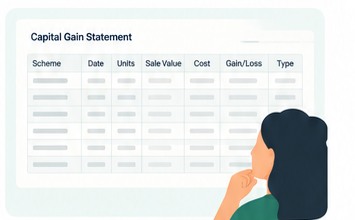
A typical capital gain statement may have the following columns:
| Column | What it means |
|---|---|
| Scheme name | Name of the mutual fund scheme |
| Folio number | Your unique account number with the fund house |
| Date of transaction | When you bought or sold units |
| Units | Number of units involved |
| Sale value | Amount you received on selling the units |
| Cost of acquisition | Amount you originally invested (adjusted for things like STP/SWP) |
| Capital gain / loss | Profit or loss from this transaction |
| Type | Short-term (STCG) or long-term (LTCG) |
04
Short-term vs long-term capital gains
The tax treatment depends on how long you held the investment before selling it.
| Type of gain | Equity mutual funds | Debt mutual funds |
|---|---|---|
| Short-term capital gain (STCG) | Units held for 12 months or less. Taxed at 20% |
Units held for 36 months or less. Added to your income and taxed as per your income slab |
| Long-term capital gain (LTCG) | Units held for more than 12 months. Taxed at 12.5% (on gains above ₹1.25 lakh) |
Units held for more than 36 months. Taxed at 12.5% (with indexation) |
Tax rates and holding periods are as understood at the time of writing and change from time to time, including through the annual Finance Act. Please confirm the position that applies to your own situation with a qualified tax professional before filing.
The holding period is calculated on a first-in, first-out (FIFO) basis, unless specified otherwise.

05
Common reasons for confusion
It is normal to feel confused when you first see your statement. Some common reasons are:
Look at the bigger picture. A single transaction does not tell the whole story.

06
A simple example
Let’s look at an example to see how the numbers work.
| Date of purchase | Date of sale | Units | Purchase amount | Sale amount | Capital gain | Type |
|---|---|---|---|---|---|---|
| 10 Jan 2023 | 15 Mar 2026 | 1,000 | ₹1,00,000 | ₹1,60,000 | ₹60,000 | LTCG (equity) |
In this example, the investment was held for more than 12 months, so it is a long-term capital gain and taxed at 12.5% — and only if your total gains exceed ₹1.25 lakh in the financial year.
An illustrative transaction, not a projection. The numbers are chosen to show the arithmetic.
07
Do you always have to pay tax?
Not necessarily. You may not have to pay tax if:
- You have a loss instead of a gain.
- Your long-term equity gains are within ₹1.25 lakh in a financial year.
- Your investments are in tax-advantaged accounts (e.g. ELSS, PPF) — though capital gains tax rules may still apply as per the latest regulation.

08
What should you check?
When you receive your statement, take a few minutes to:
- Verify that all transactions are listed.
- Check the holding period and type (STCG or LTCG).
- Match the numbers with your own records.
- Look at your overall gains or losses for the financial year.
If something looks different, it is a good idea to check with your fund house or a qualified tax professional.

09
Key takeaways
A capital gain statement is a record, not a tax demand.
Understand the key columns and the difference between short-term and long-term gains.
Look at the bigger picture, not just one transaction.
When in doubt, seek professional advice.
10
Final thoughts
Your capital gain statement may look complicated, but it is simply telling the story of your investments. Once you understand the key parts, you can read it with confidence — and without panic.
More clarity today helps you make better decisions tomorrow.

Invest with clarity.